Secrets Of Mosfet Cross Reference and Replacement Guide
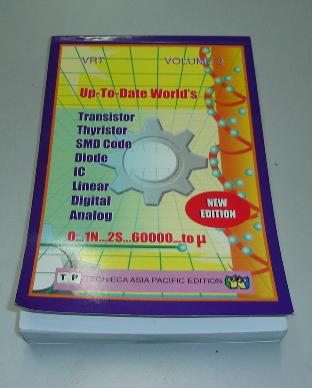
A Semiconductor Replacement Guide Searching for the right mosfet cross reference or datasheet, one has to look for a semiconductor transistor replacement data book and not the Philip ECG master replacement guide. Almost all the transistor replacement book will published out the specification of a particular components such as type of component it belong whether it is a fet, scr, bipolar transistor, horizontal output transistor and also the voltage, ampere, wattage, ohm, frequency and suggested substitution part number.
From my experienced, the substitution part number that was recommended by the data book is not always 100 % match. If you have the time, I would like to suggest to you that, find the right part number by yourself rather than depending on the transistor data book.
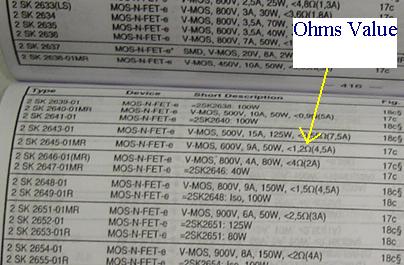
It is the same when you look for horizontal output transistor (HOT) specification which doesn't mean that the bigger specification, the better the substitution part number is. In searching for Mosfet cross reference, you have to look at the ohms value which is provided by the transistor data book besides the specification of voltage, ampere and the wattage. The replacement, besides the same or higher in voltage, ampere and wattage, one should also consider the ohms value. The ohms value has to be as close as possible.
Arrow is showing the mosfet ohms value in a transistor substituion book
If the original fet part number is 1 ohm then a good replacement mosfet must have the ohm values between of 0.5 to 1.5 ohm. Do not substitute it with a too high or too low ohms value as this will make the mosfet run warmer and eventually blow the mosfet itself. Even though you can get a replacement with a higher voltage, ampere and wattage, if the ohms value is too low or too high, the mosfet will still burnt after on for quite a while.
It runs well for sometimes before it breakdown again. After two weeks the customer brought back the printer with the same complaint which is no power. Upon checking the power side I found the same mosfet gave up again. Substituting with another mosfet part number that have a similar specification especially the ohms value solved the printer no power symptom.
Specification with larger voltage, ampere and wattage don’t guarantee that the replacement mosfet will work. So, taking the mosfet ohms value into consideration, you will have a higher chances to repaired the equipment and sometimes the replacement mosfet will also last longer.
|
|
Subtitle Honey,.we.shrunk.ourselves!.1997.720p.... 95%
It was one of the first live-action sequels Disney produced specifically for VHS.
The 1990s were a decade defined by rapid advancements in family-oriented special effects. At the tail end of this era sat Honey, We Shrunk Ourselves (1997). While often viewed through the lens of its direct-to-video status, the film serves as a fascinating study in franchise evolution, role reversal, and the limitations of early digital transitions. 🎥 From Big Screen to Home Screen subtitle Honey,.We.Shrunk.Ourselves!.1997.720p....
Rick Moranis returned for his final live-action role, providing a sense of continuity amidst an otherwise new ensemble. 🧪 The Narrative Flip: Parents as Protagonists It was one of the first live-action sequels
The phrase "Honey, We Shrunk Ourselves (1997) 720p" typically refers to a high-definition digital file of the third installment in the Disney "Honey, I Shrunk" franchise. Released directly to video in 1997, it marked a shift in the series' focus from the children being shrunken to the parents. While often viewed through the lens of its
Copyright@ 2006-2014-www.ElectronicRepairGuide.com All Rights Reserved